Judge rules 2,000 Catalina Island deer can be killed to save native plant species
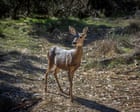
Judge rules 2,000 Catalina Island deer can be killed to save native plant species | California | The Guardian Skip to main content Skip to navigation Close dialogue 1 / 1 Next image Previous image Toggle caption Print subscriptions Newsletters Sign in US US edition UK edition Australia edition Europe edition International edition The Guardian - Back to home The Guardian News Opinion Sport Culture Lifestyle Show more Hide expanded menu News View all News US news US politics Midterms 2026 World news Climate crisis Middle East Ukraine US immigration Soccer Business Environment Tech Science Newsletters The Filter Wellness Opinion View all Opinion The Guardian view Columnists Letters Opinion videos Cartoons Sport View all Sport Soccer NFL Tennis MLB MLS NBA WNBA NHL F1 Golf Culture View all Culture Film Books Music Art & design TV & radio Stage Classical Games Design a better world Lifestyle View all Lifestyle The Filter Wellness Fashion Food Recipes Love & sex Home & garden Health & fitness Family Travel Money Search input google-search Search Support us Print subscriptions Newsletters Download the app Search jobs Digital Archive Guardian Licensing Live events About Us The Guardian app Video Podcasts Pictures Inside the Guardian Guardian Weekly Crosswords Wordiply Corrections Tips Search input google-search Search Search jobs Digital Archive Guardian Licensing Live events About Us Environment Climate crisis Wildlife Energy Pollution Green light A mule deer doe walks through a hillside behind the Descanso Beach Club in Avalon on Catalina Island. Photograph: Allen J Schaben/Los Angeles Times/Getty Images View image in fullscreen A mule deer doe walks through a hillside behind the Descanso Beach Club in Avalon on Catalina Island. Photograph: Allen J Schaben/Los Angeles Times/Getty Images California Judge rules 2,000 Catalina Island deer can be killed to save native plant species Cull of animals that eat native shrubs, causing spread of fast-igniting grasses, to go ahead despite fierce opposition Sophie Sullivan in Los Angeles Thu 3 Sep 2026 08.00 EDT Last modified on Thu 3 Sep 2026 12.32 EDT Share Prefer the Guardian on Google Locals and tourists have long fawned over Catalina Island’s mule deer population. For nearly a century, the ungulates have roamed the land’s waterfronts and woodlands, so comfortable around humans that it is not uncommon to spot deer roaming downtown Avalon. But that sight will soon disappear, after a judge this week paved the way for the island’s conservancy to kill nearly all the island’s 2,000 deer. A non-profit controlling 88% of the island off the southern California coast has been trying for years to eliminate a non-native deer population. Experts statewide have expressed support for the Catalina Island Conservancy proposal, saying the deer’s consumption of a native shrub plant has led to a growth of an invasive grass species that ignites faster and spreads fire more easily. The prospect of killing so many deer has sparked fierce – and emotional – opposition from the public, creating an unlikely coalition of animal activists and hunters that has tried to prevent the culling in court. An online petition against the move has garnered more than 32,000 signatures. Los Angeles county supervisor Janice Hahn, an outspoken critic of the deer’s killing, asked California’s governor, Gavin Newsom, to intervene earlier this week. But the plea was to no avail, and on Tuesday a county judge tentatively denied a preliminary injunction filed by opponents. The conservancy said it would now move forward with a five-year plan to eliminate the island’s deer population, according to its director of communications, Pepe Barton, with an estimated 200 to be hunted with rifles over the next two months. Formally known as Santa Catalina Island, it is the last leg of the Channel Islands to remove non-native deer species. Barton said the conservancy’s decision was “never our first choice”. “We understand the gravity of the situation and the responsibility, and it’s a noble sacrifice on the part of the deer that didn’t ask for this,” Barton said. “But this is a necessary step to protect the island, the native plants and animals that are only found here, as well as the residents and livelihoods that depend on Catalina.” California officials move forward with plans to exterminate mule deer from island Read more Hunters first introduced mule deer to Catalina for sport about a century ago. What began as a population of a few quickly grew to a few thousand, and save for minor dips in drought seasons, the island’s deer population has not dwindled. The animals developed an appetite for shrubs native to the island. That presented a unique ecological problem for the island, according to Anna L Jacobsen, a professor and plant biologist at California State University, Bakersfield, who studied the island deer’s relationship with its vegetation after its last major fires in 2006 and 2007. Jacobsen said when